#213
The Number Your Doctor Never Checks: Learn It Now or Become Sick Care’s Recurring Revenue
Today is the last weekly issue of Harder to Kill as we move to a monthly schedule. The next issue arrives November 21, and the reason for the change, and what it means for you, is at the end of this issue.
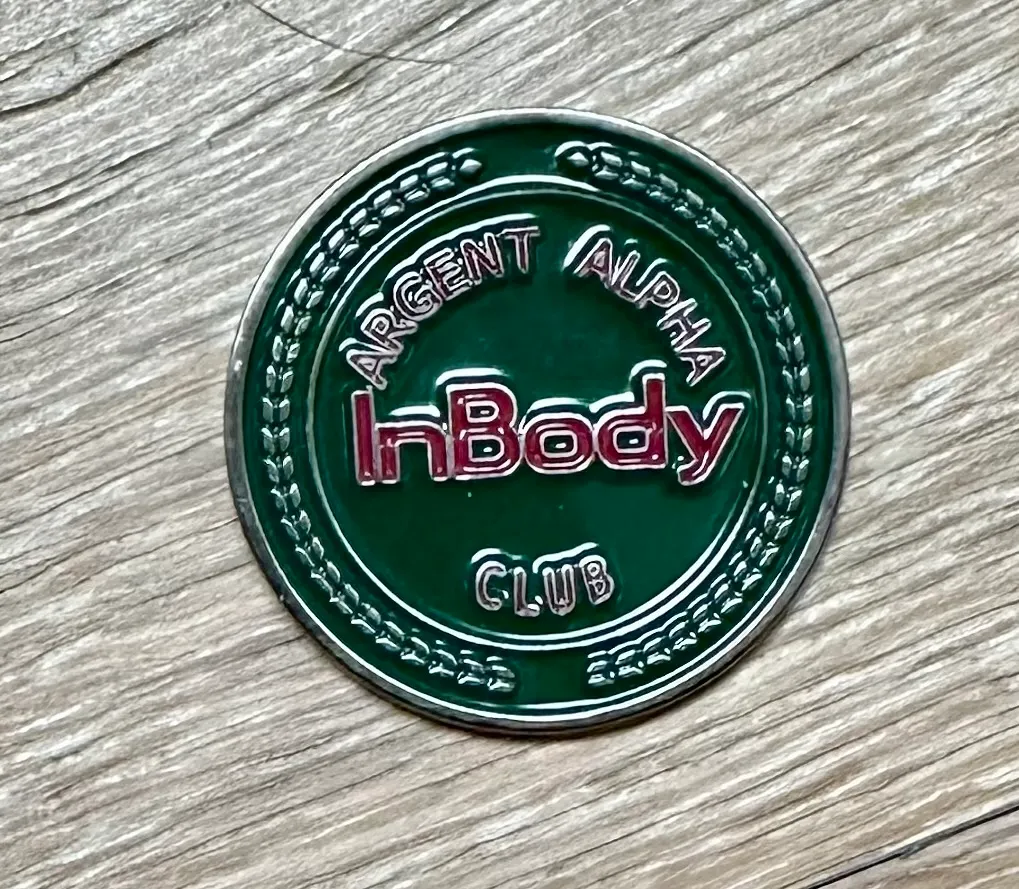
Two weeks ago at Camp Foley in Minnesota, at our fall LIVE event, three days of physical challenges and brotherhood, I had the honor of recognizing three men into the Argent Alpha 15% Body Fat Hall of Fame: John McGrath, John Malfitano, and Dan Springer. Argent Alpha is our community for men over 50, and 15% body fat is the standard we hold. Each man received a challenge coin (full recap here):

InBody coin Oct 2 LIVE VII Camp Foley
Three men, all over 60, from three different states, and each one hit 15.6% within a month of one another. Nobody planned that. What are the odds of three men landing on the exact same number?
They started between the high 20s and the mid 30s. One of them got there in under a year. Another took two and a half years. There were no shortcuts, no hacks, and no Ozempic. They scored their standards every day, reported their numbers to the other men every Monday, stood on a body composition scanner every month, and kept going when a scan went sideways. They got there on consistency and a long view.
Dan posted this with his last scan: “I came into Argent Alpha at 64. At 66 I am more healthy, fit, and capable than I was at 45.” John Malfitano posted his and wrote, “I am a new man.”
A half dozen other men in Argent Alpha, all over 50, have publicly declared that they will join the Hall of Fame by the end of the year. I’m betting on all of them. We want our HOF to be crowded with fit and healthy men over 50. You could be one of them.
Our members test body fat percentage on the InBody scan, the body composition test we run once a month. This issue covers why body fat percentage is the number you drive, what the machine measures, how to read your own printout, and why once a month is the cadence.
Why Body Fat Percentage Is the Number to Drive
Three things lie to you about your body.
The first is BMI. Your doctor divides your weight by your height squared and reads the result off a chart. BMI cannot tell muscle from fat, so it calls strong men obese and skinny-fat men healthy. Two men can be 6’1” and 210 pounds and have the same BMI. One is an NFL safety living at 8% body fat, and the other has a 38-inch waist, can’t see his toes, and has 25% body fat. BMI says they are the same.
The second is your bathroom scale. It tells the truth about one thing, your weight. It says nothing about how much of you is muscle, how much is fat, or where that fat sits. Lose 20 pounds the wrong way, sacrificing precious muscle, and you are worse off than when you started. The scale applauds you the whole way down.
The third is your buddies. “At least I’m not as bad as them.” Seventy-seven percent of American men are overweight or obese, so being in better shape than the men around you says nothing about your health. Best of the worst is still the worst division.
One number tells the truth. Body fat percentage is your fat in pounds divided by your weight in pounds, and your InBody printout labels it PBF.
The standard we set is 15%. We arrived at that number after researching body fat percentages for men across age groups, and 15% is where men are healthy, lean, and athletic. InBody built its own scoring system and landed on the same 15% standard for a man. InBody’s published chart then allows a man up to 24% in his twenties and 28% at 60 and over, and the reason the company gives is decreased muscle mass. The line loosens because the men being measured lost muscle. We offset that muscle loss every month, so we leave the line where it was. Men in Argent Alpha have reached it and held it, dozens of them, all over 50.
It is the number to drive because it moves for one reason. Eat in a caloric deficit while you lift and eat your protein, and the weight you lose is overwhelmingly fat. The percentage falls because the fat falls. Lose the weight by diet alone, with no lifting and too little protein, and as much as a quarter of what comes off is lean tissue. The scale cannot tell the difference.
There are no benefits to being fat and weak. None.
Men who get to 15% come off the meds, retire the CPAP, and get their energy back. They report lower blood pressure, a lower resting heart rate, better blood sugar, better lipids, less joint pain, better sleep, and more strength, and their bloodwork agrees with them.
If nothing changes, you get more meds, more specialists, and more auto-refills. Sick Care runs on the Netflix model, and you become recurring revenue.
The death rates say the same thing. A 15-year study of American men between 20 and 49, with body fat measured the same way an InBody measures it, found that men at 27% body fat or more were nearly twice as likely to die of any cause, and more than three times as likely to die of heart disease, as men below that line. The CDC ties excess body fat to 13 types of cancer.
What an InBody Scan Is
You step onto the platform barefoot, grip the two handles with your thumbs on the metal pads, and stand still for 30 to 50 seconds. The machine sends a small electrical current through you. Water conducts it and fat resists it. Muscle runs about 73% water and passes the current easily, while fat is nearly dry and fights it. The machine measures that resistance and calculates what you’re made of.
An InBody measures five segments separately: both arms, both legs, and your trunk. It uses no equations based on your age or sex, only what it measures on you.
We use InBody for three reasons.
Low cost. Scans run from free at some health clubs and supplement stores to about $30, and most places that offer them sell discounted bundles.
Availability. Gyms, cash-pay physicians, supplement stores, med spas, and wellness clinics all run them. Search “InBody scan near me” and you will find one.
Accuracy. InBody reports a 98.4% correlation with DEXA, the X-ray scan that is the gold standard for body composition. Same man, same conditions, same answer. DEXA costs more, lives in imaging centers, and nobody runs you through twelve X-ray procedures a year to check your body fat. We coach the trendline, so we chose the machine you can stand on every month.
Body fat percentage and skeletal muscle mass are the two numbers that matter most, and every InBody prints both. If a 270 is what your gym has, use it. If a 570 or 580 is available, get that one, because it also measures your visceral fat, the dangerous fat around your organs. I use a 580.
If the nearest InBody is three hours away, a home unit like the InBody Dial or the Hume Body Pod beats no data. The same rules apply, and scan once a month, no more often. Nothing outside your own bathroom holds you to the date, so you hold yourself to it.
There is one warning. If you have a pacemaker or an implanted defibrillator, do not use an InBody. The current can interfere with the device.
How to Read Your Scan
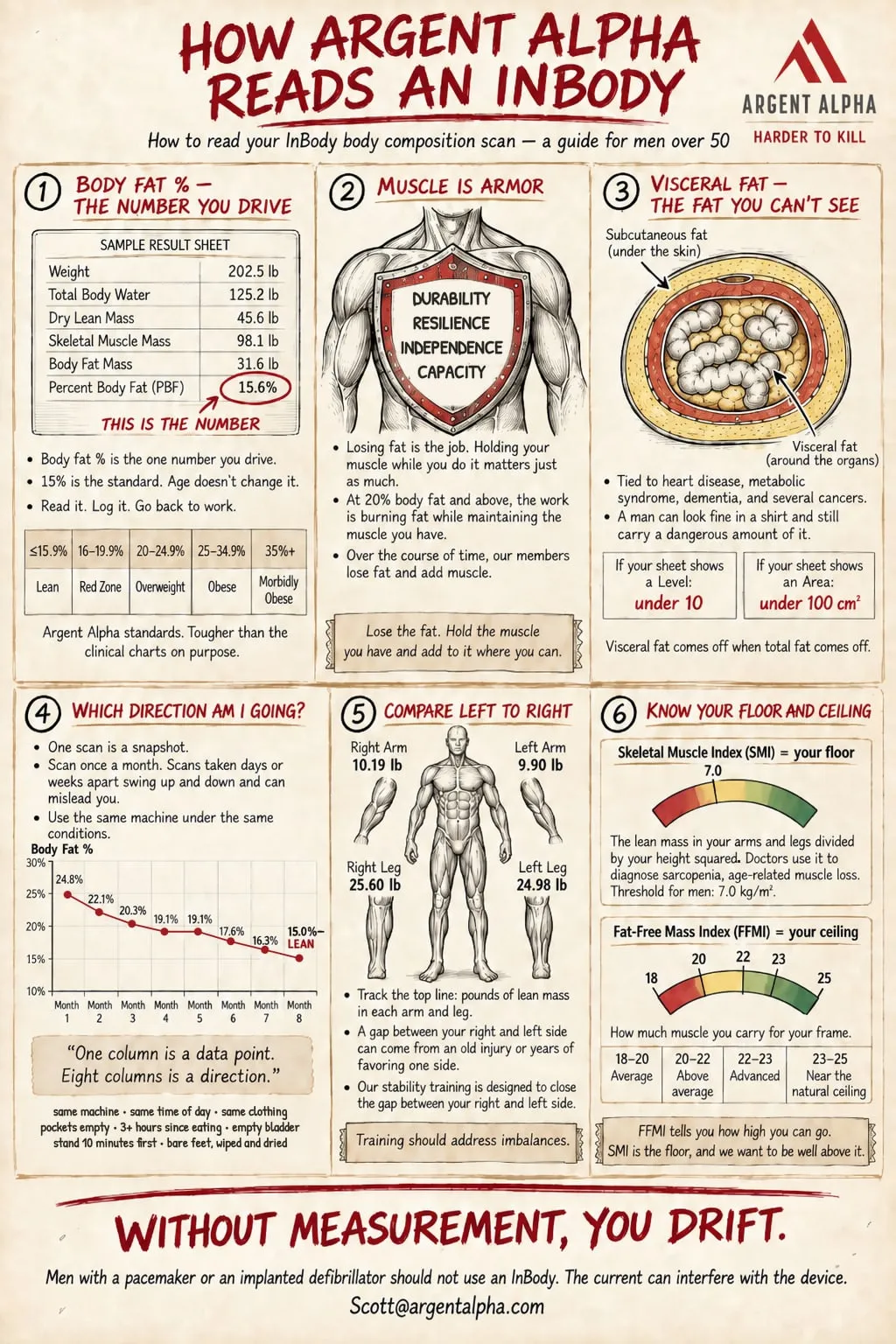
The graphic above shows the six things we read on every scan. This section tells you where each one prints on your own sheet, and adds what the graphic leaves out.
Where to find them:
- Body fat percentage prints under Obesity Analysis, labeled PBF.
- Skeletal muscle mass prints under Muscle-Fat Analysis, labeled SMM, in pounds.
- Visceral fat prints as a Level on a 570 and as an Area in cm² on a 580.
- Your arms and legs print under Segmental Lean Analysis. The top bar is pounds of lean mass, and that is the one you track.
- Skeletal Muscle Index and Fat-Free Mass Index print under Research Parameters on the machines that include them.
- Your last eight scans print at the bottom under Body Composition History.
These are the Argent Alpha bands for body fat percentage, and they run tougher than the published charts on purpose:
- 15.9% or below is lean. Any reading that starts with 15 meets the standard.
- 16% to 19.9% is the red zone. If your percentage is trending down, you are in scoring position.
- 20% to 24.9% is overweight.
- 25% to 34.9% is obese.
- 35% and above is morbidly obese.
Find your band and treat it as a starting point and nothing more. The band with the next lower percentage range is your next milestone.
I also read muscle a second way. Divide your skeletal muscle in pounds by your body weight in pounds. Our leanest men run 50% and above. Some machines print it for you under Research Parameters as SMM/WT. It is the same arithmetic as body fat percentage from the other direction, and when one improves the other follows.
About 10% of your fat is visceral fat. It sits deep in your abdomen under the muscle wall, wrapped around your liver and intestines, and it behaves like an organ. Harvard ties it to heart disease, insulin resistance, dementia, and breast and colorectal cancer. It climbs with age even when your weight holds flat, and you can look fine in a shirt and carry a dangerous amount of it. Stay under 10 if your sheet prints a Level and under 100 if it prints an Area.
Skeletal Muscle Index is your floor. It is the lean mass in your arms and legs divided by your height squared, and it is what doctors use to diagnose sarcopenia, age-related muscle loss. The threshold for men is 7.0, and we want you well above it. A study that followed older adults for up to 16 years found that the adults with the most muscle for their height carried a 20% lower risk of death than those with the least, and BMI predicted nothing. Most men over 50 have never seen this number, and it answers the question underneath every other one on the sheet. Am I going to get off the floor at 80?
Every machine prints body fat percentage, skeletal muscle mass, and the history, and those three are enough to get you started.
Why We Scan Once a Month
Most businesses report their results monthly, analyze material variances from plan, and make adjustments accordingly. Successful executives do not read a P&L every morning and make decisions off it. They spend their time driving the activities that will produce the desired results.
Likewise, we run an InBody scan once a month and we train for it. A scan date on the calendar is a commitment, and a commitment changes how you live. The five standards our men score every day, mindset, sleep, nutrition, fitness and hydration, are the leading indicators. The scan is the lagging indicator.
Monthly also matches the biology. A month of work shows up on the scan as real change, about four pounds of fat burned at the pound-a-week pace we plan around for men above 15% body fat. Scan weekly and you may get misleading feedback. Your body water changes day to day, and reading those swings as progress or failure sends you chasing numbers that mean nothing. Stick with scanning once a month.
One scan is a singular point in time. Monthly scans are your trendline. Without measurement, you drift. We see it time and time again. A man gets comfortable and goes three months between scans and guess what…fat up and muscle mass down. With a monthly scan, you catch the drift early so you can make adjustments.
Replicate the conditions to ensure comparability between scans:
- Same machine.
- Same time of day, and morning works for most men.
- Same clothing, pockets empty.
- Three hours since your last meal.
- Empty bladder.
- Stand ten minutes before you test, because water pools in your legs when you sit or sleep.
- Bare feet, wiped with a damp towel and dried.
Two pounds of jeans, a belt, and a phone in your pocket read as two pounds of fat. On a 200-pound man that is a full percentage point that does not exist. Jump between machines and you get a number that thrills you or flattens you, and you earned neither.
The date on the calendar changes the days in front of it. Men sharpen their daily standards when they know the machine is waiting. The scan is information to use to help you make adjustments. Don’t get caught up in the emotion of it. Read it, log it, and go back to work.
Download the free InBody app before your first scan. Give the machine your mobile number when you test, or scan the QR code on its screen when the test ends, and your results sync to your phone. The app keeps your result sheet and your history, so you can compare one month against the next without digging out the printouts. Our members like it.
What a Win Looks Like
Any reading that starts with 15 meets the standard, and the standard holds at every age, whether you are 50 or 80. We have dozens of examples of men achieving and sustaining 15% or lower body fat in every decade: 50s, 60s, and 70s. We are still looking for our first 80-plus-year-old man, so if you know one, send him our way. We don’t bend the knee to Father Time.
At 30%, looking at 15% means looking at a fifteen-point gap and a year of work. You work toward the next band. Hit 28, set 26. Hit 26, set 24. We call it the Road to 15%: milestone driven, four-to-eight-week missions, one band at a time, about a pound of fat a week.
Very few trendlines run straight. A zig-zag with the overall trend pointed the right direction is the objective. The last milestones can move less for the same work, because there is less fat to burn than when you started. Across hundreds of men over four years, a couple pounds of muscle across a 20-to-50-pound fat change is the cost of doing business. We have also had many men add muscle while losing fat.
Measure from where you started. Dan Sullivan and Dr. Benjamin Hardy call it the Gap and the Gain. Men who measure the gap are never satisfied. We talk about the progress from where you started, and men who measure the gain keep going.
The half dozen men who declared for the Hall of Fame by year-end are on that road now, each one measured against his own first scan.
What to Do This Week
Find an InBody near you and book a scan. Download the InBody app and use the locator at the bottom of the dashboard, or search “InBody scan near me.” A 570 or 580 gives you visceral fat too, so ask which model they run when you call. Scan in the morning, three hours after your last meal, and stand up for ten minutes before you step on.
Write down three numbers with the date: your body fat percentage, your skeletal muscle mass in pounds, and your visceral fat. Divide your skeletal muscle by your body weight and write that down too.
Before you leave, book the second scan 30 days out, on the same machine at the same hour.
Give your first number no emotional weight. It carries no grade. Since day one of Argent Alpha I have said the same thing: no man likes his first scan, whether it reads 13% or 36%.
Then join one of our communities. Harder to Kill or Argent Alpha, and the choice between them is covered below.
Watch, Read, Listen
Watch — How To Read Your InBody 570 Results. A walk through the 570 printout, panel by panel.
Read — InBody 580 Result Sheet Interpretation, InBody. The company’s own walkthrough of the 580 printout in pounds: body water, Muscle-Fat Analysis and the C, I, and D shapes, Obesity Analysis, Segmental Lean Analysis and imbalances, Visceral Fat Area, and Body Composition History.
Listen — Dr. Gabrielle Lyon on the Huberman Lab podcast, June 2024. Why skeletal muscle is the organ of longevity, and how protein and resistance training keep it.
Why We’re Moving to Monthly
Today’s issue marks 213 consecutive weekly issues of sharing concepts, ideas, methods, tools, and experiences of what is helping men over 50 become harder to kill. Today is the last weekly issue as we move to a monthly schedule. The next issue will be November 21, the Saturday before Thanksgiving, and we will focus on how we get through the holidays and come out better and stronger as the quarter ends. Our December 26 issue will be a close look at how we do annual planning so you can make 2027 your best year yet.
But why the switch to monthly? I turn 62 next month, and one thing I fully embrace is the value of time, yours and mine. A newsletter gives you information. Results come from applying it, with methods, tools, and other men holding you accountable, and that happens inside our two communities. They complement each other, like stepping stones, and every hour I move from writing weekly to working inside them helps all of our members get results.
Harder to Kill, the name of our workshop community and the name of this newsletter, is where men come as a next step: to learn more about how men over 50 are achieving these results, apply the methods, use the tools, and get started on improving their health and fitness. The first thing you open is the recording of our first workshop, The Number Your Doctor Never Checks, which covers the scan you just read about.
Our original community, Argent Alpha, puts you into the same membership that is producing dozens of lean, strong, fit, healthy men over 50, men like John McGrath, John Malfitano, and Dan Springer. Many men reading this newsletter are ready to join Argent Alpha today. For others, Harder to Kill is the better place to start. If you know you are ready, willing and able, join Argent Alpha here.
My goal: join one, get started.
You will still get massive value from the monthly newsletters, and if you want more support, more tools, and more accountability, join one of our communities.
Over 300 men have become harder to kill through our two communities, and thousands more from my Amazon bestselling book and 213 issues of this newsletter. If you want my read on which community fits you, email me at info@argentalpha.com.

Argent Alpha LIVE VII: SISU @ Camp Foley