#212
Five Things I'm Working On to Close Q4 Strong (and How You Can Do Each One)
The last quarter of 2026 (Q4) started on October 1 and ends on December 31. I am using it to close the year strong and build momentum for 2027. This is your invitation to join me.
This issue covers five things I’m working on right now with the men of Argent Alpha, our community of men over 50. You can do every one of them yourself, starting today.
This Week’s Playbook
- 1. Pick One Goal for the Rest of 2026 — the question that finds it, and my own goal with my starting numbers
- 2. Remove What Competes With It — what Gary Keller’s book The ONE Thing says to cut
- 3. Set a Daily Rep Total — a short report from our fall event at Camp Foley, and the method three squads used there
- 4. Walk 1,000,000 Steps by December 31 — the math, and three ways to join late
- 5. Put a Date on Your Calendar — three men, two endurance events, and a new podcast episode
1. Pick One Goal for the Rest of 2026
For a number of years I was a member of AMP, a coaching program run by Dr. Benjamin Hardy, the psychologist who wrote Be Your Future Self Now. One of his trainings was on what he calls a keystone goal.
Hardy defines a keystone goal as the one outcome that, if it became true, would make your future self possible. Your future self is the man you are working to become.
He teaches one goal because of how motivation works. Hardy says motivation requires three things:
- an outcome you want
- the belief that you can reach it
- a path to get there.
When you chase five outcomes on five paths, you get pulled in five directions and your motivation drops.
Hardy asked us one question in that training: “What if you accepted that one goal is a foregone conclusion? How would that change how you operate?”
A group of us inside Argent Alpha are running a keystone goal from October 1 through December 31. Each goal needs four things:
- A number
- A date
- Your starting number
- Your reasoning
My goal is 15 strict reps in three grips (pull-ups, neutral-grip pull-ups, and chin-ups) plus the full 30-rep Sally push-up routine, all by December 31. Sally is 30 push-ups done in time to the Moby song “Flower.”
I started the quarter at 9 pull-ups (pronated grip), 12 neutral-grip pull-ups, 13 chin-ups, and 15 reps of Sally. I hit the various pull-up targets at Level 59 and got to 23 reps in Sally. Next month I turn Level 62. My rep count was a bit low coming into the quarter due to golfer’s elbow which I was able to overcome with the Fiix Elbow device (one of our members is the co-founder). I’m going to prove you can get better even while drawing a social security check.
I picked this goal because of what it requires. To reach those numbers I have to hold my daily standards for mindset, sleep, nutrition, fitness, and hydration for three straight months. Working on one goal brings the other areas with it. When I complete this goal, I’ll be stronger, leaner, and I’ll strengthen my identity as a man in his 60’s who can do hard things. That translates to every part of life.
Write down two or three goals you could work on between now and December 31. For each one, write what else improves if you hit it. The goal that improves the most other things is your keystone goal. Choose that one.
2. Remove What Competes With It
Our group is reading Gary Keller and Jay Papasan’s book The ONE Thing this quarter. Keller built the book around one question: “What’s the ONE Thing I can do such that by doing it everything else will be easier or unnecessary?”

The book supports the keystone goal. It helps you filter out the things that will not help you reach it.
He puts it this way: “Success demands singleness of purpose. You need to be doing fewer things for more effect instead of doing more things with side effects.”
Hardy makes the same point with a line from the writer Robert Brault: “We are kept from our goal, not by obstacles, but by a clear path to a lesser goal.” I wrote a full issue on that quote in February, called The Clear Path to a Lesser Goal.
Hardy compares your other goals to open tabs on a computer. Seven open tabs slow the computer down. Seven open goals do the same thing to you, because part of your attention stays on each one. He says you close a tab two ways: you finish the goal, or you decide to drop it.
Two steps put this to work:
- List the actions you take in a normal week toward your keystone goal. Mark the few that produce most of your progress. Hardy calls these the 20%.
- List the other goals and commitments that take your time between now and December 31. Decide which ones you will drop.
3. Set a Daily Rep Total
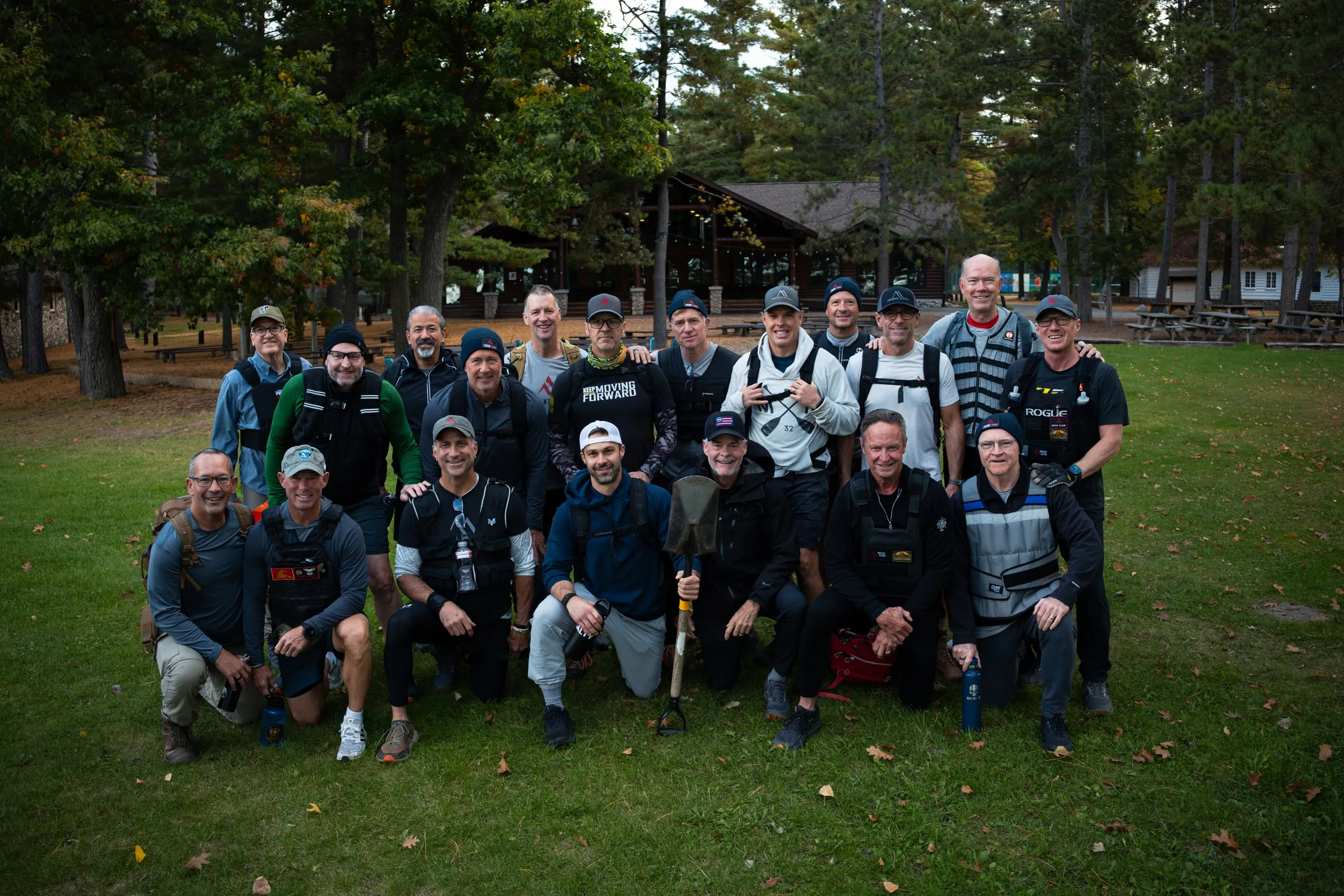
Twice a year the men of Argent Alpha meet in person for three days. Last weekend, October 2 through 4, we were at Camp Foley in Pine River, Minnesota. A full report is coming in a later issue.
We split into three squads of six men. Each squad had a total to hit between Friday and Sunday at noon:
- 900 push-ups
- 36 minutes of planks
- 60 minutes of wall sits
- 180 burpees
Each squad’s captain called the reps, and the squad chose when to do them. At least two squad members had to be present for every rep. One man could cover reps for another, because the squad total was the only number that counted.
Those reps came on top of everything else on the schedule. On Saturday morning we wore rucksacks for four hours in the woods and did pull-ups, dips, bear crawls, log lifts, and tire flips. Each squad still had to finish its totals by Sunday at noon. And by the way, our strength coach, Brock Harling, led the morning with an amazing warm-up that included foundation training among other things. I like to say “our warm-up is harder than your workout.”
So the squads did them in pieces. My squad did all 180 burpees on Friday night. On Sunday morning two squads did their wall sits together in the trees to finish off the reps. There was a consequence for any squad not completing their reps and thankfully we never learned what that was but I’m pretty sure Coach Brock would have included burpees in that penalty.
Dan S., one of our members, wrote this afterward: “Something about doing it with your guys that makes it so much easier.”
You can use the same method on any day when you have no time for a workout:
- In the morning, write down a total for the day in a few movements. Push-ups, squats, wall sits, planks, burpees, and jumping jacks all work.
- Work through the totals during the day, a few reps at a time, whenever you have a few minutes.
You finish the day with a full workout and you never set aside a block of time for one. For a starting point, go for 50 pushups, 5 minutes of wall sits, and 3 minutes of planks. Do the push-ups in sets of 5, and hold the wall sits and planks for 30 to 60 seconds at a time and you’ll never break a sweat. But get your reps done throughout the day. You’ll feel it (in a good way) while never having gone to the gym.
4. Walk 1,000,000 Steps by December 31
Our challenge for October, November, and December is to walk 1,000,000 steps. Spread across the 92 days from October 1 through December 31, that is an average of 10,870 steps a day.
Getting 10,000 steps in a given day is not a big deal for most men. But averaging 10,870 steps every day for 92 days? That takes intention.
As I write this I have logged 112,038 steps and I’m in 7th place among the men in the challenge. We aren’t competing but when you have a leaderboard let’s just say it motivates you to do the work.
You can join today. Your phone has likely been counting your steps since October 1, so you have three ways in:
- Count what you already have. Open the health app on your phone, add up your steps since October 1, and keep going from that total.
- Walk 10,870 steps a day from today. Add those steps to whatever you have walked since October 1.
- Start from zero today. Divide 1,000,000 by the number of days left in the year. On October 10 there are 83 days left, counting that day, and the answer is 12,048 steps a day.
Track your steps every day and record your total at the end of each month. And this is much more fun and attainable when you do it with a friend.
5. Put a Date on Your Calendar
This week I interviewed three Argent Alpha members about one idea: put an event on your calendar and train for it.
TJ R. rode LoToJa on September 12. LoToJa is a one-day bike race of more than 200 miles from Logan, Utah to Jackson Hole, Wyoming.
Sean D. and Brandon A. did Elevation Everest on September 26 in Winter Park, Colorado. You hike up a ski mountain, ride the gondola down, and repeat, with the aim of climbing the height of Mount Everest, which is 29,029 feet. Sean and Brandon entered as a two-man relay team. They climbed for 17 hours, part of it by headlamp. The time cutoff came before they reached the full height, and they finished second out of 10 teams.
Six days later, all three men were at Camp Foley with us.
A few things they said in the interview that you can use:
- Pick an event where finishing is uncertain. That was Brandon’s advice. He also said to find a training partner who is better than you.
- Bring your family into the plan. TJ talked through his training schedule with his family before he started. His wife and son met him out on his training rides.
- Keep going when the plan changes. Sean injured his calf near the halfway point of Elevation Everest. He slowed down and kept climbing. Brandon said that watching Sean continue made him push harder.
- The training pays off outside the event. Brandon said he got more productive at work while he was training.
Brandon and Sean have their next events picked. Brandon is entered in the Norwegian Foot March on April 17, an 18.6-mile march with a 24-pound pack, and he plans to run a full marathon next year. Sean is training for HYROX, an indoor fitness race, with a February target.
You can hear the full conversation on YouTube or Spotify.
Then pick your own event, sign up, and write the date on your calendar.